
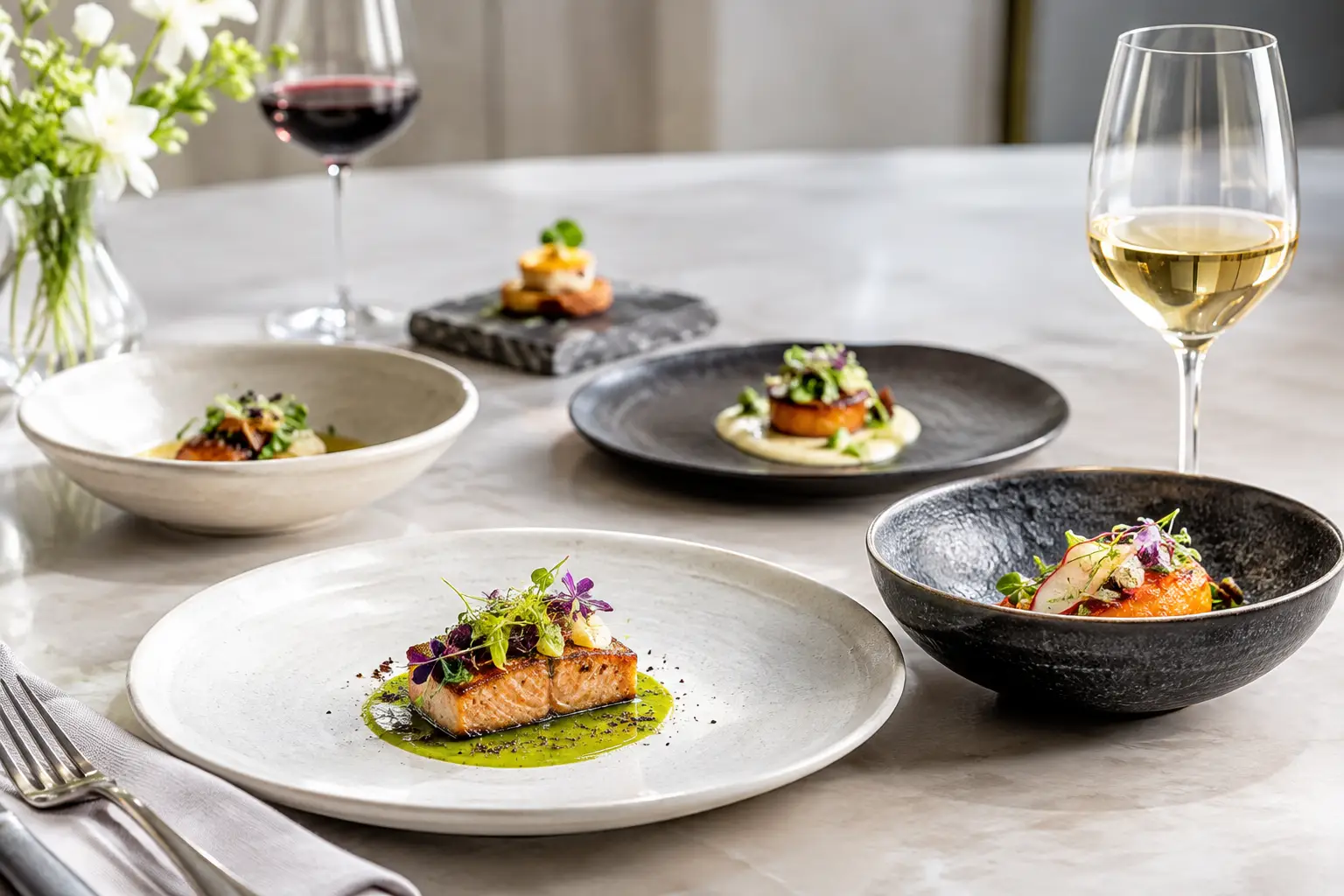
The card says $295 per person. Then come the wine pairing, a supplemental course featuring white truffle, tax, and service. By the time the final mignardise is cleared, the tasting menu cost can feel startlingly different from the number that secured the reservation. That does not automatically mean the restaurant is playing a trick. It means a tasting menu is a carefully choreographed evening, and the price reflects far more than what is placed on the plate.
For diners planning an anniversary, a client dinner, or a culinary trip, understanding the structure of that bill makes the experience easier to choose – and easier to enjoy once you are in the dining room.
What a Tasting Menu Cost Usually Covers
At its simplest, a tasting menu is a fixed sequence of courses selected by the chef. Rather than ordering a main course and deciding when you have had enough, you are buying a complete point of view: perhaps 10 courses, perhaps 20 small gestures, each designed to arrive in a particular order.
The food cost is only one part. Consider the work behind a single composed bite of caviar over warm potato: someone has received and inspected the fish eggs, made the cultured cream, turned the potatoes, clarified the garnish, polished the silver, and timed the course with the rest of the room. Fine dining relies on intensive preparation and unusually high staffing levels, often with cooks assigned to exact stations and servers responsible for only a handful of tables.
A higher menu price can also reflect ingredient seasonality and scarcity. Peak-season uni, live scallops, heritage poultry, dry-aged beef, Japanese fruit, truffles, and imported shellfish are expensive before a chef begins to transform them. But luxury ingredients alone do not explain the bill. A superb vegetable-focused menu may cost as much as one built around lobster because precision, technique, and labor are major drivers.
Location matters, too. Rent, wages, insurance, and demand in Manhattan, San Francisco, Miami, Las Vegas, and major dining destinations create a very different operating reality from that of a small city. Michelin recognition or an internationally known chef can increase demand, but the most meaningful question is whether the restaurant delivers a level of cooking and hospitality that feels commensurate with its price.
Typical Tasting Menu Price Ranges in the US
There is no universal tasting-menu price, but a few broad ranges are useful when you are deciding where to book. A thoughtful chef’s counter or neighborhood destination may offer a five- to eight-course experience for roughly $85 to $175 per person. In larger markets, ambitious tasting menus commonly land between $175 and $350 before drinks, tax, and gratuity.
At the rarefied end, menus at elite restaurants can begin around $400 per guest and move significantly higher when premium supplements, celebratory bottles, or reserve wine pairings enter the picture. A destination meal for two can therefore become a four-figure evening without anyone ordering extravagantly.
These ranges are directional, not a verdict on value. A $165 menu may be the better meal if it has a clear culinary identity, gracious pacing, and ingredients handled with care. Conversely, a $400 menu can feel thin if the courses are more theatrical than delicious or if the room treats hospitality as an afterthought.
The number to look for before booking
Read the reservation page as closely as you would a wine list. Does the listed price include service? Is tax included? Are there optional supplements, such as wagyu, caviar, truffle, or cheese? Does the restaurant require a full prepayment, a deposit, or only a card hold?
Those details determine whether $250 per person means roughly $300 at the end of the night or something closer to $450. They also reveal the restaurant’s style. A menu that is explicitly all-inclusive offers clarity; one with a lower entry price and many optional additions gives diners more choice, but asks them to manage the total more actively.
Why Wine Changes the Tasting Menu Cost So Quickly
Wine is where a planned splurge often becomes a serious expenditure. Pairings may be offered in several tiers: a standard selection, a reserve pairing, a nonalcoholic pairing, and occasionally a focused program built around Champagne, Burgundy, or sake. At a strong restaurant, a pairing is not simply a collection of small pours. It is a second narrative, calibrated to move from saline and high-acid wines toward more structured bottles as the meal deepens.
That work has value, yet pairing is not always the best financial or sensory choice. If one person drinks and the other does not, ordering by the glass can be more sensible. If you are celebrating and want a single bottle to follow the meal, ask the sommelier for something with enough freshness to travel across several courses. A bottle can offer better value than two pairings, especially when the menu includes multiple seafood and poultry courses rather than a procession of intensely flavored meats.
Do not overlook zero-proof pairings. They are often priced closer to a wine pairing than a soft drink because they may involve house ferments, teas, juices, distillates, and painstaking service. If alcohol is not part of the occasion, this can be one of the most revealing ways to experience the chef’s intended contrasts – but it is still an add-on worth budgeting for.
Tax, Gratuity, and Service Charges
The final math differs by city and restaurant. Sales tax can add a meaningful amount, and gratuity practices vary widely. Some restaurants add a service charge automatically, often around 18% to 22%. Others leave gratuity to the guest, while a growing number build hospitality into the stated price.
A service charge is not always identical to a tip, even if it supports front- and back-of-house compensation. The reservation confirmation or menu should explain the policy. If it does not, a brief question before or during the meal is entirely appropriate. This is not penny-pinching. It is the same kind of useful fluency as asking whether the menu can accommodate a shellfish allergy.
For a realistic budget, calculate the menu price plus beverages, then add local tax and 20% unless the restaurant clearly states that service is included. Leave room for supplements if you know a truffle course or caviar addition will tempt you. The easiest way to resent a tasting menu is to treat its entry price as its final price.
When the Splurge Is Worth It
A tasting menu earns its cost when it gives you something that an excellent à la carte dinner cannot: a concentrated encounter with a chef’s imagination. The best meals make a sequence feel inevitable. A bright spoonful of raw seafood sharpens the appetite; a warm, savory course gathers depth; dessert offers more than sweetness, providing a final change of temperature or texture that makes the evening linger.
That said, more courses do not inherently mean more pleasure. Some diners prefer the generosity and freedom of à la carte ordering. Others find three hours at the table exhilarating, while their companions begin checking the time after the fifth course. A tasting menu is best for guests willing to surrender some control in exchange for surprise, pacing, and a fuller view of the kitchen’s voice.
It is also wise to match the restaurant to the occasion. For a business dinner, a menu with a predictable two-hour format and a flexible beverage program may be more useful than an elaborate chef’s counter. For a milestone, the more immersive room may be exactly the point. Tell the restaurant about significant dietary restrictions when booking, not after the amuse-bouche arrives, and be honest about whether anyone at the table is uneasy with raw seafood, offal, or extended meals.
How to Book With Confidence
Before confirming, decide what experience you are actually buying. Are you seeking a new chef, a famous room, a wine program, or simply an occasion that feels special? Then set an all-in per-person ceiling rather than focusing solely on the base menu price. It allows you to say yes to a pairing or a supplement deliberately, rather than feeling cornered by the menu.
Once seated, let curiosity do some work. Ask the server what the kitchen is especially excited about that night, or ask the sommelier whether a half bottle, a glass, or a lighter pairing makes the most sense with the menu. Good hospitality welcomes those questions.
The memorable tasting menu is not necessarily the most expensive one. It is the meal whose cooking, room, and rhythm feel right for the people at the table – and whose final bill holds no surprises beyond the delicious kind.