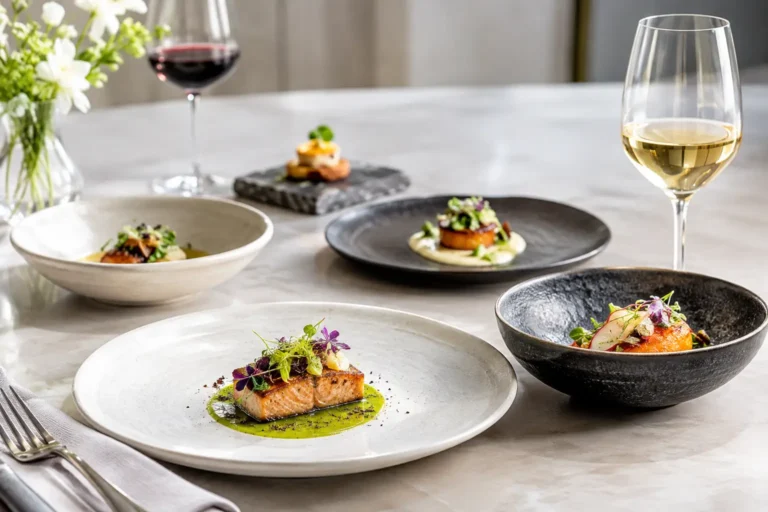

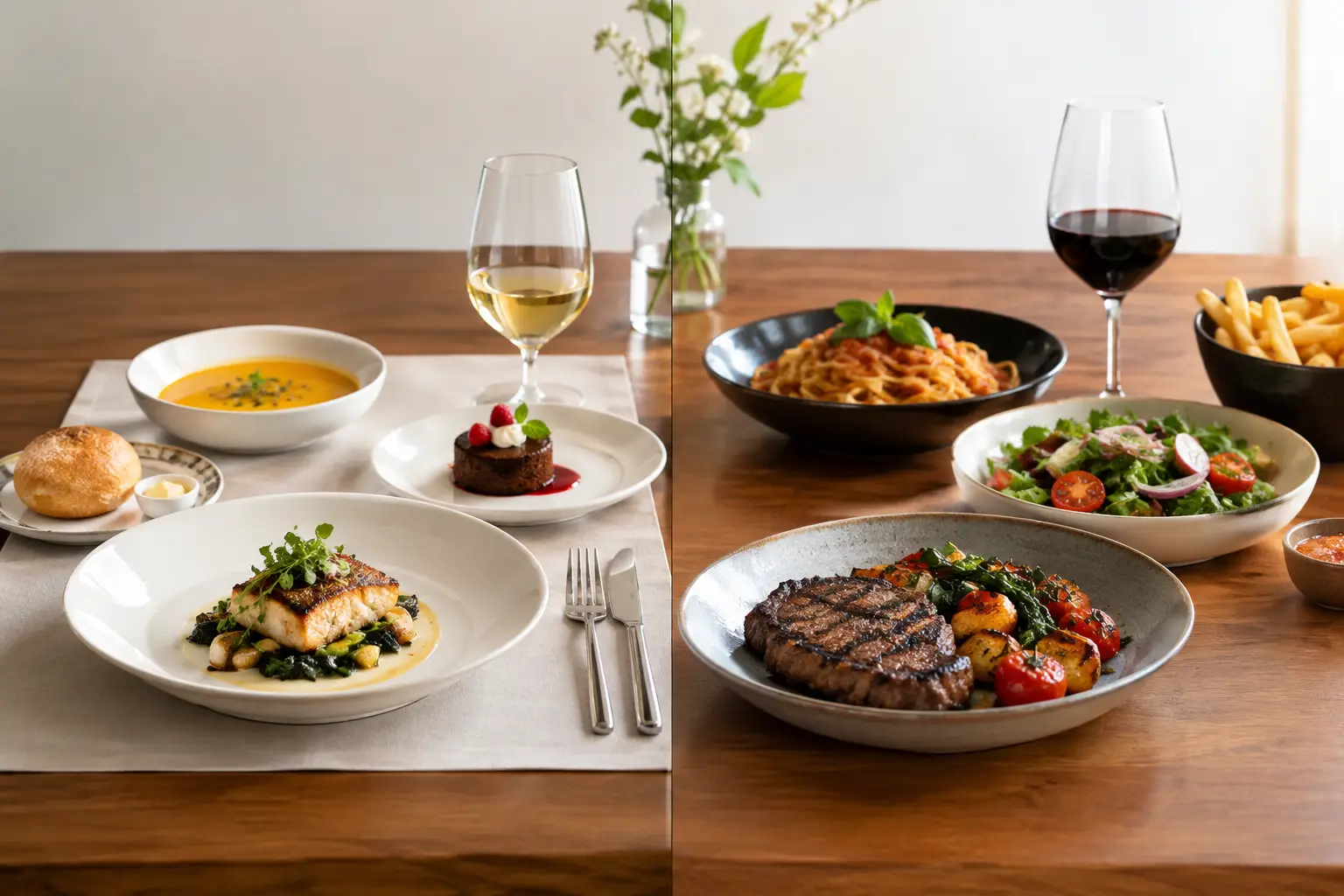
The menu lands, and the decision is already shaping the night. On one side: a $135 tasting menu, eight courses chosen by the chef, with a possible wine pairing. On the other: a la carte starters, entrées, sides, and dessert, all yours to assemble. Prix fixe versus a la carte is not simply a question of how much dinner costs. It is a choice between surrendering to a point of view and directing your own meal.
For a first visit to a chef-driven restaurant, an anniversary table, or a destination reservation booked weeks ahead, that distinction matters. The format affects pacing, appetite, wine, conversation, and whether everyone at the table leaves feeling indulged rather than overcommitted.
What prix fixe and a la carte actually mean
A prix fixe menu, French for “fixed price,” offers a predetermined sequence of courses for one stated price. In its simplest form, it may be a three-course choice: select one appetizer, one entrée, and one dessert from a limited list. At its more ambitious, it becomes a tasting menu, where the kitchen decides every course and builds a narrative from opening bite to petits fours.
The key distinction is structure. A prix fixe dinner has a beginning, middle, and end conceived in advance. It may feature a smoked oyster followed by hand-cut pasta, then duck glazed in cherry jus, each course calibrated in portion and intensity. The diner is buying the chef’s progression as much as the food itself.
A la carte means ordering each dish separately. You might share crudo and roasted carrots, choose a ribeye with pommes purée, skip dessert, or order two starters instead of an entrée. Prices are attached to individual dishes, and the table has more control over quantity, timing, and spending.
Neither format is inherently more luxurious. A beautifully edited a la carte menu can be every bit as exacting as a tasting menu. Likewise, a three-course prix fixe at a neighborhood bistro can be an efficient, approachable way to eat well on a weeknight. The difference is how much authorship the restaurant retains and how much it hands to you.
Prix fixe versus a la carte: the experience at the table
The strongest case for prix fixe is trust. When a restaurant has a clear culinary identity, letting the kitchen lead often produces the most coherent meal. A chef can use a tiny first course to sharpen your palate, then move through richer flavors without exhausting it. You may encounter ingredients or techniques you would never have selected from a menu – a chilled corn custard, say, or a single raviolo filled with sweetbreads and morels – but remember long after the reservation.
Prix fixe also changes the pace. Courses arrive in a rhythm set by the kitchen, which can make a celebratory dinner feel ceremonial. There is less time spent comparing dishes, negotiating shared plates, or wondering whether you ordered enough. For diners who find a large menu oddly stressful, that relief is part of the value.
The trade-off is real, though. A fixed menu asks for time, appetite, and openness. At a serious restaurant, dinner may occupy two and a half to four hours. The sequence may be difficult for a selective eater, a diner avoiding certain ingredients, or anyone who simply does not want a rich final course after a late lunch. Dietary accommodations are often possible with advance notice, but they are not the same as total freedom.
A la carte offers a different kind of pleasure: the pleasure of reading the room and ordering accordingly. On a business dinner, it allows each guest to settle at their own comfort level. One person can have a salad and grilled fish; another can share oysters, order the lamb, and add a bottle of Barolo. At a lively restaurant where the menu changes with the market, a la carte can feel spontaneous and generous rather than less considered.
It is also usually better for groups. A table of four can sample more of the kitchen when dishes are shareable, and no one is locked into the same appetite or spending threshold. Just ask whether the restaurant’s format encourages sharing. At some fine-dining rooms, individual plating is central to the experience, and passing plates around can disrupt the intended presentation.
Cost is more complicated than the menu suggests
A prix fixe price is clear, but it is not always all-inclusive. Taxes, gratuity, supplements, beverages, and wine pairings can move the final check considerably. A $165 tasting menu can become a $300 evening per person once a pairing and service are added. That is not a warning against it. It is a reason to look at the full commitment before you reserve.
A la carte can appear less expensive because the entry point is lower. An entrée priced at $48 may sound restrained next to a $125 prix fixe. But add a $22 appetizer, a $16 side, $14 dessert, and a few shared items, and the arithmetic changes quickly. For a complete restaurant experience, a la carte is not automatically the budget option.
The practical question is what kind of value you want. Prix fixe tends to offer a more complete view of the kitchen for a known food price. It can be especially compelling at lunch, during restaurant week, or at restaurants whose tasting menus include techniques and ingredients absent from the regular menu. A la carte is more economical when you want a shorter meal, are dining lightly, or prefer to devote more of the budget to wine.
Watch for a hybrid format, increasingly common at ambitious restaurants. You may choose a three-course prix fixe, then add caviar, truffles, a cheese course, or a signature dish for an additional charge. These menus can provide welcome flexibility, but they can also invite incremental spending. There is nothing wrong with a supplement that genuinely excites you. Order it because it is the dish you came for, not because the menu has made restraint feel like a missed opportunity.
When to choose prix fixe
Choose prix fixe when the restaurant itself is the occasion. If you have booked a sought-after dining room to understand a chef’s cooking, the tasting menu is often the clearest statement of that kitchen’s ambition. It is also well suited to birthdays, anniversaries, and culinary travel, when the meal is meant to be an event rather than a pause between plans.
It works best when everyone at the table wants roughly the same experience. Ask about duration, dietary policies, and whether the entire table must participate before finalizing the reservation. If you are considering wine pairings, remember that they are designed to illuminate each course, not necessarily to pour generously. For some diners, sharing a bottle or choosing glasses a la carte provides more satisfaction and a gentler pace.
A prix fixe menu can be a fine choice for a first date, but only if both people welcome the commitment. There is romance in a long meal with surprises. There is less romance in discovering halfway through course four that your companion hates shellfish and had hoped to leave in 45 minutes.
When a la carte is the smarter order
Choose a la carte when flexibility is the luxury you need. It is ideal for a weekday dinner, a mixed group, a meeting where conversation matters more than culinary theater, or a return visit to a restaurant whose menu you already know. It also gives you room to follow appetite rather than obligation.
This is the format for ordering strategically. At a steakhouse, skip the predictable starter if what you really want is a dry-aged strip and a proper side of creamed spinach. At an Italian restaurant, share antipasti and pasta, then decide whether an entrée still sounds good. At a seafood restaurant, spend on pristine raw fish and a bottle of Chablis instead of forcing a formal three-course arc.
A la carte rewards a little menu literacy. Look for dishes that signal the kitchen’s particular strength: a whole fish, a house-made pasta, a sauce requiring serious technique, a seasonal vegetable preparation that would be hard to replicate at home. The goal is not to order the most expensive item. It is to find the dishes that explain why this restaurant exists.
Read the menu before you book
The best decision happens before you arrive hungry. Check whether the reservation is for a tasting menu only, whether the whole table must order it, and whether cancellation terms apply. At high-demand restaurants, prix fixe menus are often prepaid or charged for late cancellations because the kitchen has purchased and prepped for a precise number of diners.
For either format, consider the occasion honestly. A lavish tasting menu after a matinee and before an early flight may be technically possible but poorly timed. An a la carte dinner at the bar may be more memorable than rushing through a meal that deserves attention.
The confident diner is not the person who always chooses the most elaborate option. It is the person who recognizes what kind of night the table calls for. Sometimes that is a choreographed procession of small, astonishing courses. Sometimes it is one perfect entrée, a shared dessert, and enough room left in the evening for another glass of wine.