The best dinner parties do not announce themselves as productions. They begin with a cold drink in hand, something salty within reach, and a kitchen that does not require the host to vanish every 12 minutes. Learning how to plan a dinner party menu is less about demonstrating every technique you know than building a sequence that feels generous, composed, and possible to execute.
A memorable menu has rhythm. It gives guests a bright opening, a little anticipation, a satisfying center, and an ending that feels like a decision rather than an afterthought. The dishes should speak to one another, but they do not need to share an ingredient or arrive with restaurant-level ceremony. At home, the greater luxury is a host who gets to sit down.
Start with the occasion, not the recipe folder
A menu for six friends on a rainy Friday should not be planned like an anniversary dinner for two, and neither should resemble a holiday table with three generations and competing dietary needs. Before choosing a dish, name the occasion and the feeling you want to create. Are you aiming for candlelit and leisurely, or is this a loose Sunday supper where everyone reaches for another spoonful of braised beans?
Guest count matters as much as mood. Four to six people allows for more precise plating and a main course cooked close to serving. Eight to 12 calls for food that can be portioned, held warm, or passed at the table. Beyond that, think in terms of platters, braises, roasts, and composed salads rather than individual à la minute plates.
Then take stock of constraints with the clear-eyed calm of a good chef de cuisine. Ask about allergies and dietary restrictions early. Consider your oven space, burners, refrigerator capacity, serving platters, and how long you honestly want to spend cooking after your guests arrive. A menu that depends on one pan for four separate components is not ambitious. It is a scheduling problem.
Build the menu around one point of focus
Every strong dinner party menu needs a focal point: a roast chicken with crisp skin, a lacquered side of salmon, a bubbling pan of baked pasta, a platter of lamb chops, or a vegetarian centerpiece such as whole roasted cauliflower with a deeply savory sauce. This is the dish guests remember, so let it determine the rest.
If the main course is rich, give it relief. Short ribs want a bitter greens salad, sharp pickles, or horseradish cream more than another buttery side. If you are serving briny, delicate fish, avoid burying it beneath aggressively smoky vegetables or a weighty cream sauce. The aim is contrast without conflict: richness against acidity, softness against crunch, warm food against something fresh and cool.
A useful way to test the menu is to describe each course in a few words. If your opener is fried, your main is creamy, and dessert is chocolate ganache, the night may feel delicious for the first three bites and exhausting by the last. Shift one element toward brightness or texture. A shaved fennel salad, citrusy granita, or fruit-forward dessert can reset the palate without making the dinner feel austere.
Think in a progression, not a collection
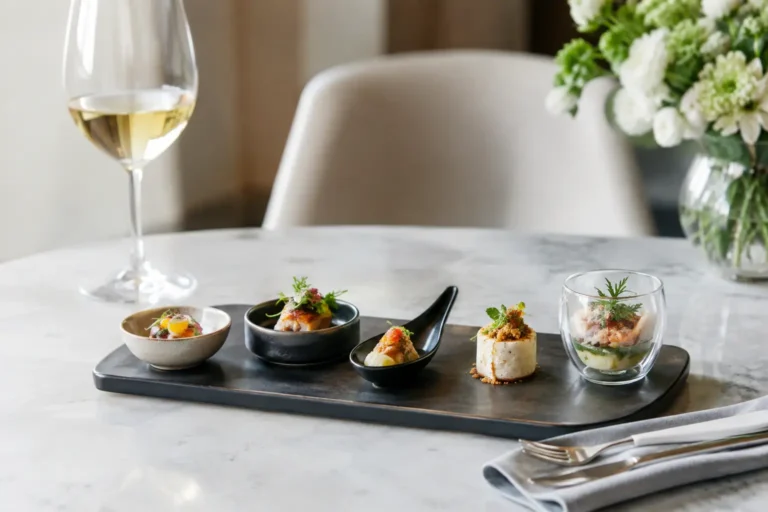
The menu should gather momentum. Start with an aperitif and a small bite that can sit comfortably while people arrive. Move to a first course that wakes up the appetite, then bring in the main course with enough substance to carry the evening. Dessert can be modest. After a generous dinner, a beautiful tart, poached pears, or excellent ice cream with a crisp cookie often lands better than an elaborate final act.
This does not mean every dinner needs four formal courses. For many gatherings, drinks and snacks, one generous main course with two supporting sides, and dessert is the most elegant format. A first course earns its place when it changes the pace or offers a flavor the main course does not. A bowl of chilled pea soup before roast chicken in spring makes sense. A fussy salad that delays a perfectly good pasta dinner may not.
Use contrast to make familiar food feel considered
Restaurant menus are often built on a quiet architecture of temperature, texture, and acidity. That same logic makes home entertaining more polished. Pair a silky soup with a crisp garnish. Serve roasted meat with an herbaceous sauce or vinegar-spiked condiment. If a dish is beige, add something green, red, or jewel-toned, not for social media but because the table should look as alive as the food tastes.
Be wary of repeating dominant flavors. A menu built around lemon can be cohesive, but lemon in the aperitif, salad dressing, fish sauce, and dessert begins to feel like a theme night. The same is true of truffle, chili, balsamic glaze, and smoked paprika. Repetition works best when it is subtle: toasted nuts in the appetizer and dessert, or fresh herbs that appear in different forms across the meal.
Seasonality is your most reliable shortcut to flavor. In summer, tomatoes, corn, peaches, basil, and grilled vegetables need little manipulation. In colder months, lean into the depth of squash, chicories, mushrooms, citrus, beans, and long-cooked meats. Buying ingredients at their best reduces the need for culinary theatrics.
Plan your dinner party menu around the clock
The difference between a graceful evening and a frantic one is usually decided before anyone rings the bell. Choose at least one major component that improves when made ahead: a braise, tart dough, dessert, vinaigrette, marinated vegetables, stock-based sauce, or salad dressing. The day-of work should be mostly roasting, reheating, assembling, and setting out.
Avoid stacking too many last-minute tasks. A risotto, pan-seared scallops, fried appetizer, and soufflé may all be excellent individually, but together they trap you at the stove. If you want one high-attention dish, make everything around it forgiving. Serve a restaurant-worthy duck breast with a make-ahead potato gratin and a salad dressed at the last minute, rather than adding three other dishes that need perfect timing.
Write a service timeline, even for an informal dinner. Note what can be done two days ahead, the day before, and in the final hour. Include the unglamorous details: chill the wine, set out serving utensils, clear refrigerator shelves, slice bread, and transfer butter to a small dish. Hospitality often fails in the gaps, not in the recipes.
A practical rule is to finish the kitchen before guests arrive. There will always be a sauce to warm or a salad to dress, but your counters should be clear enough that an unexpected early arrival feels welcome rather than catastrophic.
Choose wine with the whole table in mind
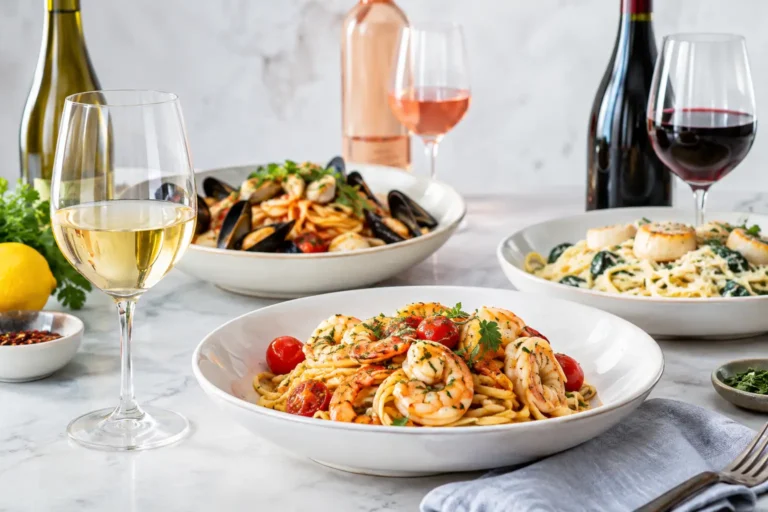
Wine pairing need not mean opening a different bottle for every course. For a mixed group, begin with one sparkling, white, or light red option that works through the opening of the meal, then move to a bottle suited to the main course. The point is not to perform sommelier theater. It is to make the food and conversation feel more generous.
Acid is especially useful when the menu contains richness. Champagne or other traditional-method sparkling wine can handle salty snacks, fried bites, creamy cheeses, and many seafood starters because its freshness keeps the palate moving. A high-acid white such as Sauvignon Blanc can brighten herb-forward dishes and goat cheese; Chardonnay with measured oak can flatter roast chicken, lobster, or a creamy sauce.
For red wine, match weight before matching color. Pinot Noir is a natural companion to duck, mushrooms, salmon, and herb-roasted poultry. Cabernet Sauvignon can be compelling with ribeye or lamb, but its tannin may make a delicate first course taste metallic or thin. When the main course is spicy, sweet-glazed, or built around strong acidity, a lightly chilled red or an aromatic white is often a better answer.
Offer plenty of sparkling and still water, and make a thoughtful nonalcoholic drink part of the plan rather than a consolation prize. A chilled hibiscus tea with orange, a bitter citrus spritz without alcohol, or a good tonic with cucumber and herbs belongs on the table with the same confidence as the wine.
Let the table support the food
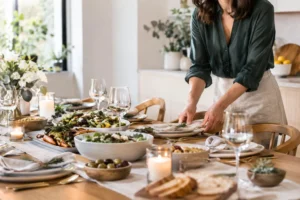
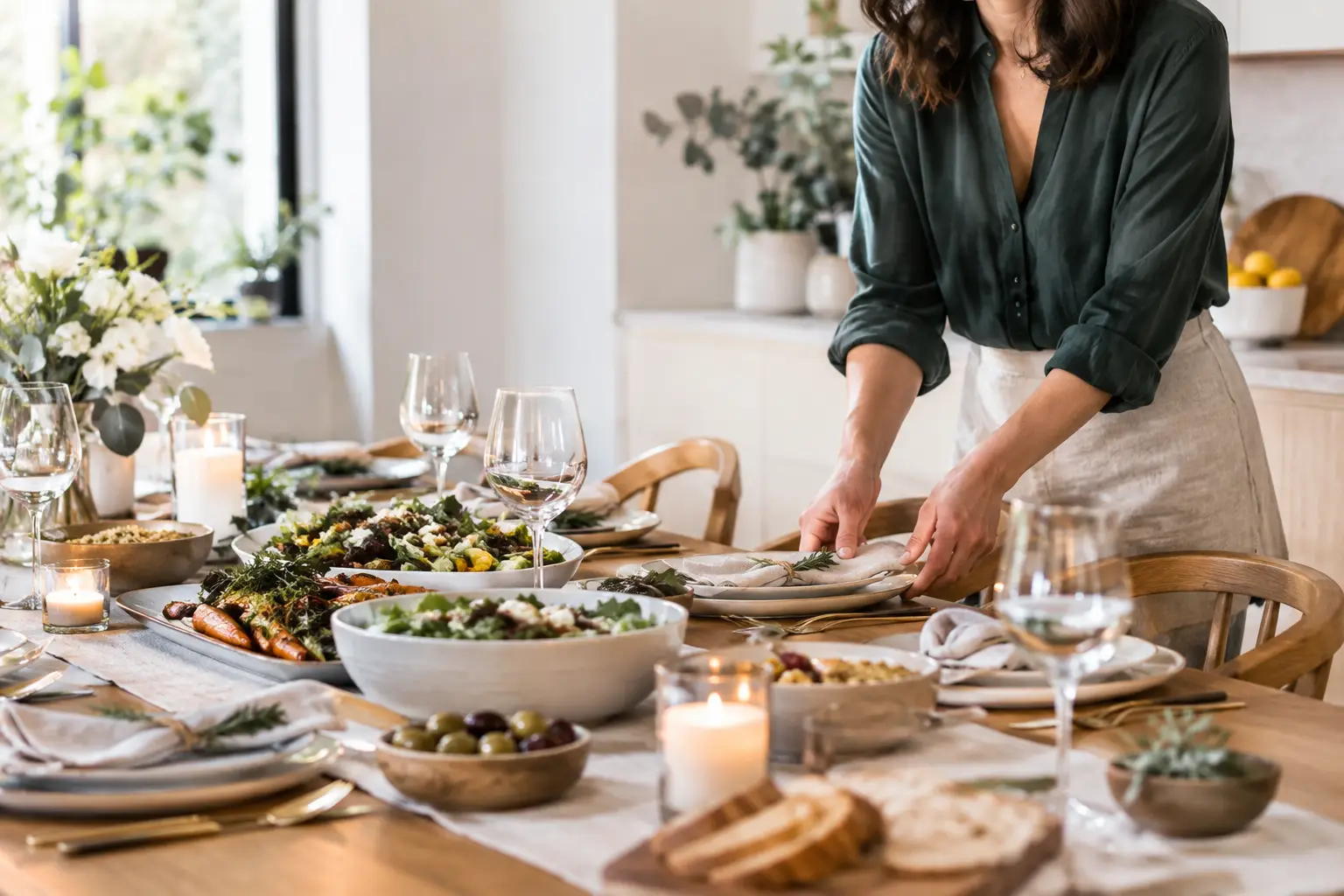
You do not need matching china or a florist’s budget. You do need enough room for guests to serve themselves, place a drink down, and see one another. Low candles are more flattering than towering centerpieces, and a bowl of fruit, branches, or a few small vessels of flowers can do more than a crowded arrangement.
Serve family-style when the food benefits from abundance: a roast presented whole, a large salad, a platter of vegetables, or a spoonable side dish. Plate individually when portions need control or when a composed first course would lose its shape in transit. Either choice can feel elevated. What matters is whether the service style makes the meal easier and more inviting.
A final detail: leave yourself an off-ramp. Keep a good store-bought dessert in reserve, buy more ice than seems necessary, and choose one course you could simplify if the day gets away from you. Guests will remember the candlelight, the crackle of the roast, the wine poured at the right moment, and the fact that you were there to enjoy it with them. That is the real menu.