
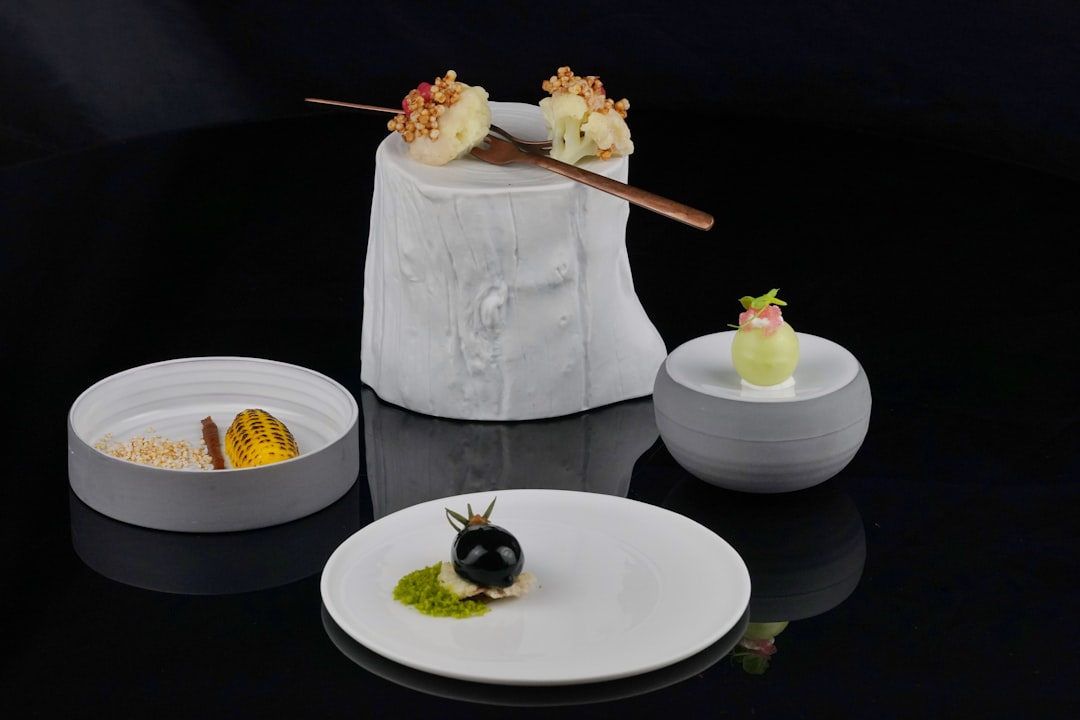
The matte black orb sits in front of you at Alinea, softly lit by candlelight, and the first course of a 22-course tasting menu has already been prepared and waiting inside it. A sealed envelope rests beside the orb, marked with a gold insignion. As each layer of the orb is peeled back, another course emerges beneath: honey-laden, floral, spring-green, each one building on the anticipation of the last. You have not yet unfolded your napkin, and the chef has already begun making an argument.
This is how a recent evening at Alinea in Chicago begins. Chef Grant Achatz’s restaurant does not hand you a menu with prices down the right margin. It hands you a sequence: a performance, a structured argument delivered in roughly 22 or 23 courses across three and a half hours. The argument is not written in words. It is written in flavor, texture, temperature, and pacing, and by the time the final course arrives, you will have been led through a complete arc: light to rich, delicate to bold, savory to sweet, and back to gentle.
A tasting menu is not a list of dishes you choose from. It is a curated sequence in which the kitchen decides what you eat, in what order, and at what pace. Understanding it as a structured argument, rather than a parade of small plates, is the single shift in perspective that turns the format from an expensive mystery into a readable, rational, and deeply rewarding experience. Each course is a paragraph in an essay the chef is writing on your palate, and the essay has a beginning, a middle, a pivot, and a resolution.
For a practical walkthrough of what to expect if this is your first time, our guide to the tasting menu for first-timers covers pacing, portions, and the question of fullness in detail. This piece goes deeper: into the mechanics of why each stage exists, what it is designed to accomplish, and how the best kitchens in the world use the format to build something no a la carte menu can deliver.
How a Tasting Menu Builds: Course by Course
Every tasting menu follows a dramatic arc: light to rich, delicate to bold, savory to sweet. The arc is not arbitrary. It is engineered, and each course occupies a specific position within it. Skip a stage and the argument loses coherence. Rush the pacing and the diner’s palate flattens. The structure exists because the human palate has limits, and the kitchen is working within them.
The Amuse-Bouche: The Thesis Statement
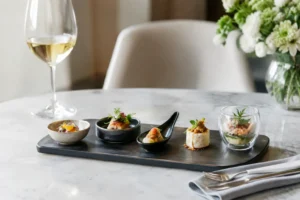
The amuse-bouche, pronounced ah-mooze-boosh and translating literally as “mouth amuser,” is the first thing that arrives. It is not on the menu. You did not order it. It comes as a gift from the kitchen, and its function is to state the chef’s thesis in a single bite.
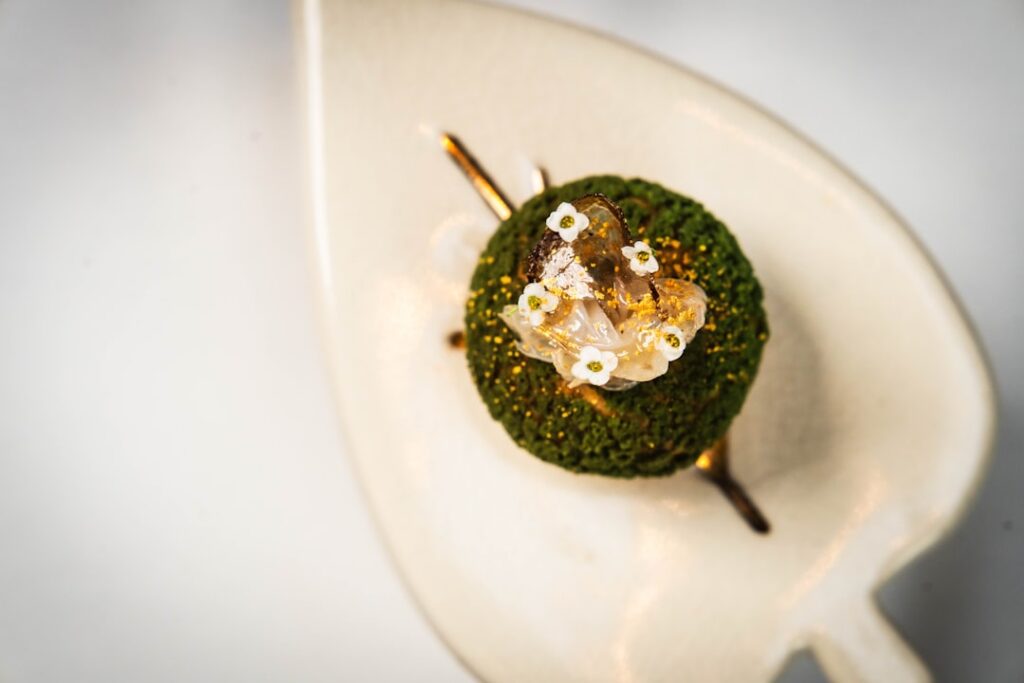
At Alinea, the opening of the current menu arrives as a bees nest: a layered hive of dishes built around honey, floral notes, and spring alliums. Each layer peels back to reveal the next course beneath. In that first unveiling, the kitchen has already told you what the meal will be about: sweetness, seasonality, and the playful dismantling of expectations.
At The French Laundry in Yountville, the amuse-bouche often includes the restaurant’s iconic salmon cornet: a tiny tuile cone filled with salmon tartare and sweet red onion creme fraiche, designed to be eaten in one bite with the fingers. In that single gesture, Chef Thomas Keller has stated his thesis: American ingredients treated with French classical technique, and the refusal to separate elegance from pleasure.
The amuse-bouche is the overture. It is a compressed statement of everything that follows, and it primes your palate with bold, concentrated flavor before the formal courses begin. Pay attention to this first bite. It tells you more about the chef’s sensibility than any menu description ever could.
The Opening Courses: Establishing the Terms
After the amuse, the kitchen establishes the terms of the argument. This typically means a sequence of cold preparations: raw fish, cured dishes, delicate vegetable compositions. The logic is functional. Raw and acidic flavors stimulate salivation and awaken the palate. Starting with a heavy, rich course would deaden the senses for everything that follows.
At Noma in Copenhagen, the opening courses are shaped by what the foraging team has gathered that week. When the restaurant reopened in August 2026 under a new “twelve seasons” format, each month received its own distinct menu, shaped by the ingredients, landscapes, and weather of that specific moment. An August visit might open with sun-kissed berries, fragrant flowers, and sweet seafood. By October, the same structural position in the menu would feature wild mushrooms, game meats, and red shellfish. The argument changes with the season, but the structure holds: light, acidic, raw, and then building.
The opening courses are where the chef introduces the vocabulary of the meal. If the kitchen leans toward Japanese restraint, you will see it here. If it leans toward French classical technique or Nordic foraging, the opening courses are where that sensibility first speaks clearly. These are typically three or four bites each: a single oyster with cucumber granita and herb oil, a custard of sweet corn and sea urchin, a cured hamachi with yuzu kosho and a single chrysanthemum petal. Small, precise, and designed to wake the palate up.
The Savory Heart: The Central Argument
The middle of the menu is where the kitchen commits its strongest claims. After the light, acidic opening, the progression builds toward richness, technical ambition, and the most deliberately sourced ingredients on the menu. This is the central argument, and it is where the chef has likely been refining individual dishes for months.
The French Laundry’s most iconic dish, “Oysters and Pearls,” has occupied a position near the top of this section since 1994. A sabayon of pearl tapioca with Island Creek oysters and Osetra caviar, it is widely considered one of the most significant dishes in American culinary history. The restaurant also follows a principle that no single ingredient appears twice in a meal, which means every course in the savory heart must make its point with entirely different materials than the course before it.
At Alinea, the savory heart unfolds across multiple acts, moving from the kitchen itself back to the dining room. A barely cooked Aleutian king crab, rich but controlled. A hand-harvested Hokkaido scallop with passionfruit and Dijon. A steamed Spanish turbot with Perigord black truffle and banana mousseline. Each dish is a separate claim in the same argument, building in intensity and technical complexity.
The savory heart generally moves from delicate to bold. A hand-rolled pasta with brown butter and sage might serve as a structural midpoint, substantial enough to anchor the meal without overwhelming what follows. Then the richness deepens: a slow-braised short rib with bone marrow jus, a dry-aged duck breast with cherry reduction, a roasted squab with fermented black garlic. These are the courses that carry the most technique and the most expensive ingredients, and they are the courses the kitchen has staked its reputation on.
The Intermezzo: The Pivot
Somewhere around the fifth or sixth course, a familiar feeling surfaces. You have eaten well. The richness has accumulated. You do a quiet calculation: how many courses are left?
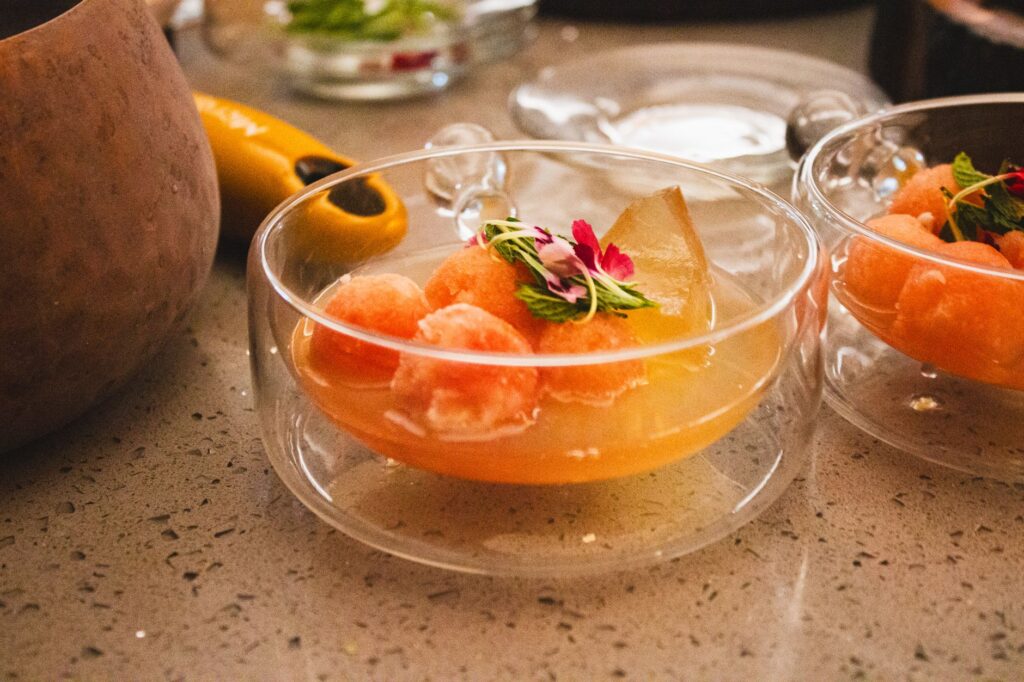
This is the exact moment the intermezzo arrives. The intermezzo, an Italian term meaning “interlude,” is a palate cleanser served between the savory courses and the dessert. It is typically a citrus sorbet or a granita: cold, sharp, almost astringent, designed to strip away the accumulated fat and richness of the preceding courses.
The intermezzo does not exist to feed you. It exists to reset your palate so the sweet courses that follow feel approachable rather than overwhelming. A yuzu sorbet, a Campari and grapefruit granita, a cucumber and mint ice: these are the archetypes. The kitchen knew you would feel the weight of the savory progression, and built the solution into the structure of the meal itself.
For a deeper breakdown of how every course type functions within the fine dining sequence, our guide to decoding the fine dining menu maps each structural element from amuse-bouche to mignardise.
The Main Protein: The Strongest Claim
After the intermezzo, the kitchen delivers its strongest single claim: the main protein course. This is where sourcing, technique, and creative ambition converge on a single plate. It is often the most expensive course on the menu, and it is the course most likely to force silence at the table.
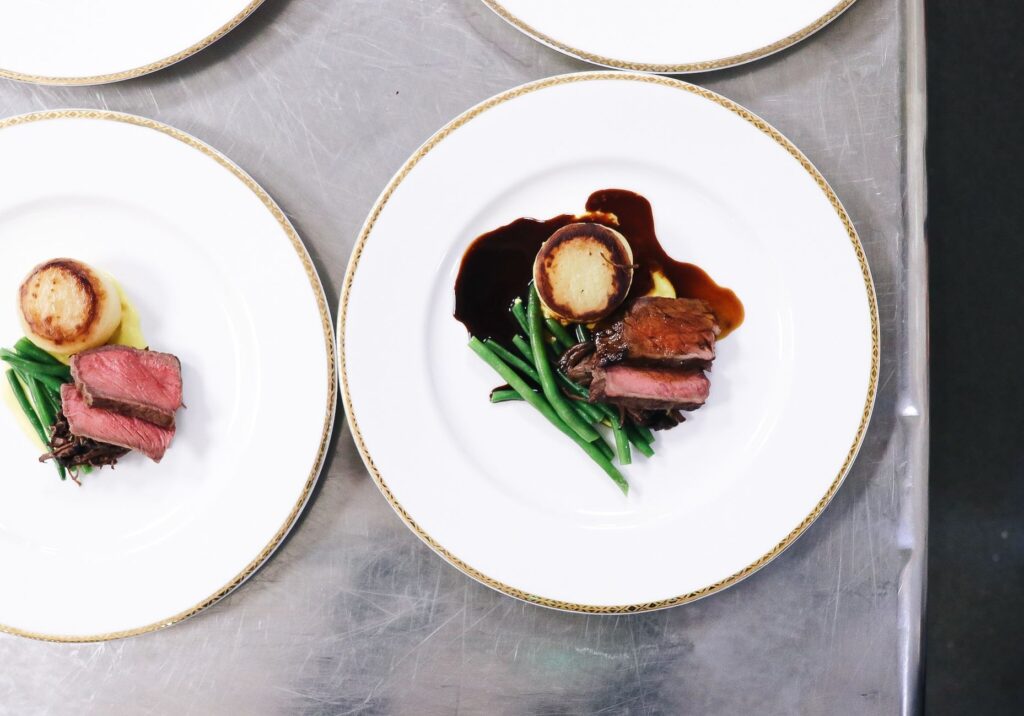
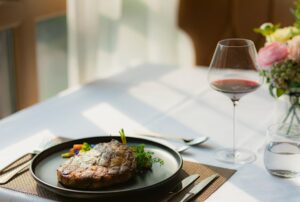
At Alinea, the ribeye of Japanese Wagyu beef arrives as the 22nd course in a 23-course menu. It is the kind of dish that produces what one reviewer described as “immediate silence.” At The French Laundry, the main course might feature A5 Japanese Wagyu, dry-aged prime beef, Colorado lamb, or Liberty Farms duck breast, rotated with the season and the market. The preparation is classical, the sourcing exact, and the effect is the culmination of everything the savory heart has been building toward.
The main protein is not always the most complex course. Sometimes it is the simplest: a perfectly cooked piece of fish, a single cut of meat, a clean sauce. Its power comes from position. By the time it arrives, your palate has been primed by the opening courses, built by the savory progression, and reset by the intermezzo. The main protein lands on a palate that is fully awake and fully prepared to receive it.
The Sweet Finish and Mignardises: The Resolution
The argument does not end with the main protein. It resolves. The transition from savory to sweet is handled in stages, not in a single jump, because a palate still calibrated for rich savory flavors would experience a sudden dessert as a shock rather than a conclusion.
First comes the pre-dessert, a small, lightly sweet course that bridges the transition. A strawberry consomme with a drop of basil oil. A lemon-thyme sorbet with a crumble of shortbread. A single perfect fig with a quenelle of goat cheese mousse. The pre-dessert introduces sweetness gradually, easing the palate across the boundary.
Then the main dessert arrives. At Alinea, the current menu closes with “Paint,” the restaurant’s iconic finale: chefs enter the dining room and transform the table into a canvas, layering sauces, powders, chocolates, fruits, and textures into an edible work of art before your eyes, before a sphere shatters and each guest’s dessert becomes uniquely their own. It is theatre, but it is also structure: the final claim in the argument, delivered with the full weight of everything that preceded it.
Finally, the mignardises arrive: two to four small, sweet bites alongside coffee or tea. A dark chocolate truffle with a clean snap. A pate de fruit that bursts with concentrated fruit flavor. A tiny financier with a crackling crust and an almond-soft center. These are the final punctuation marks of the meal, designed to leave a last impression that is gentle rather than overwhelming. The argument ends not with a shout but with a whisper.
| Stage | Position | What It Accomplishes | Real-World Example |
|---|---|---|---|
| Amuse-bouche | Before the menu | Thesis statement; primes palate; introduces the chef’s voice | Alinea’s layered bees nest hive |
| Opening courses | Courses 1 to 3 | Establishes terms; light, acidic, raw; awakens the palate | Noma’s foraged seasonal openings |
| Savory heart | Courses 4 to 7 | Central argument; builds richness, technique, and sourcing | The French Laundry’s “Oysters and Pearls” |
| Intermezzo | Mid-menu pivot | Resets the palate; strips accumulated richness | Citrus sorbet or Campari granita |
| Main protein | Course 8 to 10 | Strongest single claim; most expensive ingredients | Alinea’s Wagyu ribeye (course 22) |
| Pre-dessert | After intermezzo | Bridges savory to sweet; introduces gradual sweetness | Fruit consomme or sorbet crumble |
| Mignardises | Final | Resolution; gentle last impression; punctuation | Chocolate truffles, pate de fruit, financier |
Why Chefs Choose the Format
The tasting menu did not begin as a marketing strategy. It began as a philosophy about authority and expertise. The format traces its roots to Japanese kaiseki, a multicourse meal rooted in the tea ceremony and dating to the 16th century, in which the host served a sequence of seasonal dishes in a prescribed order. When French nouvelle cuisine chefs visited Japan in the 1960s, they were struck by the structure and adapted it into what they called the menu degustation: a sequence of small courses in which the chef, not the diner, controlled the progression.
As the French chef Alain Ducasse has explained, tasting menus are a way to understand the world of the chef: the vision, the philosophy, and the cuisine. It is, in his words, “a summary of what a chef can offer.” The format gives the kitchen complete control over pacing, progression, and pairing, which is precisely what makes it so powerful and, when it fails, so frustrating.
The economics also favor the format. A tasting menu eliminates choice, which simplifies sourcing, reduces waste, and allows the kitchen to plan portions to the gram. Every component can be prepped in advance, every plate pre-portioned, every course timed to arrive at the precise moment the preceding one is cleared. The format is as much an operational decision as a creative one.
In the 1990s, the format expanded dramatically. Thomas Keller at The French Laundry and Ferran Adria at El Bulli in Spain lengthened their tasting menus to dozens of courses, sometimes 40 or more, and the accolades that followed inspired a generation of chefs to do the same. The format became synonymous with ambition, and ambition became synonymous with length.
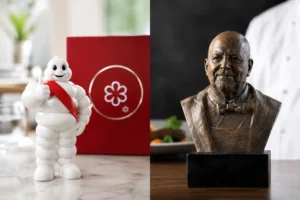
For a look at how the Michelin inspection process evaluates the food that results from this creative control, our guide to how Michelin stars are awarded walks through the five criteria and the anonymous inspection process in detail.
What the Tasting Menu Asks of the Diner
A tasting menu is not a passive experience. It asks for your time, your attention, and your trust. Most tasting menus run two and a half to four hours, depending on course count and pacing. A compact menu of five to seven courses takes about two to two and a half hours. A ten to twelve course menu fills three hours or more. An extended format like Alinea’s, with 22 or 23 courses, can run three and a half hours or longer. You should not schedule anything immediately after.
It also asks for your trust. You are surrendering the decision about what you eat to the kitchen, and in exchange you are receiving the meal the chef wants you to have, not the meal you might have constructed for yourself. This is the core transaction of the format, and it is the one that divides diners most cleanly. If you want to eat what you want, the tasting menu will feel constraining. If you want to be surprised, it will feel liberating.
The format asks for dietary transparency, too. If you have allergies, intolerances, or restrictions, mention them at the time of booking, not when you sit down. The kitchen plans its menus days in advance, with every component prepped and portioned. Announcing a restriction at the table forces rushed substitutions instead of thoughtfully designed alternatives.
Somewhere around the fifth or sixth course, a familiar anxiety surfaces. You have eaten well. The courses keep coming. You do a quiet calculation: how many are left? You worry that you have made a mistake.
You have not. The kitchen has done this math thousands of times. Portions are small but cumulative, calibrated to the gram so that by the final course you feel satisfied, not stuffed. The anxiety is part of the format, and the intermezzo is the kitchen’s built-in response to it. Trust the structure.
For a full walkthrough of the practical questions: what to wear, how long it takes, whether you will be full, and how to handle the wine pairing, our guide to what to expect your first time at a tasting menu addresses each one directly.
The Line Between Art and Excess
Not every tasting menu succeeds. The format has a natural tension at its core: the longer the menu, the more scope the chef has to make an argument, and the more likely the diner is to experience food fatigue before that argument concludes.
At Alinea, one reviewer noted that by the time the roasted peanut sponge arrived in the fourth act, impressive as it was, “the food fatigue starts to set in.” At 22 or 23 courses, the sheer scale of the menu begins to weigh on the experience. A dish can be technically perfect and still arrive at a moment when the palate has had enough.
The criticism is not new. The format’s expansion in the 1990s, when Keller and Adria pushed menus to 40 courses or more, set a template that not every kitchen could sustain. More courses means more pressure on pacing, more opportunities for the argument to lose coherence, and more risk that the diner stops engaging with the food as a creative statement and starts experiencing it as an endurance event.
The best tasting menus manage this tension through structural discipline. The intermezzo resets the palate. The pre-dessert bridges the transition to sweet. The mignardises end gently rather than grandly. The kitchen calibrates portions so the cumulative volume lands in the zone between satisfied and stuffed. When these mechanisms work, the argument holds. When they do not, the format reveals its weakness: a long meal that no longer justifies its own length.
The question for the occasion diner is not whether the tasting menu is worth it in the abstract. It is whether the specific restaurant you are considering has built a structure that can sustain its own ambition. Read the menu before you book. Trace the arc. Where does it start? Where does it peak? How does it resolve? If you can see the logic of the progression, the kitchen has done its job. If you cannot, it may not be the right evening for this particular format.
If you are weighing whether this kind of evening fits your occasion at all, our comparison of fine dining and casual dining breaks down the room engineering, staffing, and pacing that separate the two experiences, so you can match the format to the night.
Frequently Asked Questions
Here are answers to the questions occasion diners ask most often before booking a tasting menu.
Where to Read Next
A tasting menu is a commitment of time, money, and attention, but for the right occasion it is one of the most distinctive meals you can have: a single evening shaped entirely by one kitchen’s point of view, from that first spoon of something unexpected to the last square of dark chocolate at the end of the night.
The Dining Post covers the full spectrum of the dining experience, from how to read a room before you book to what is worth ordering when you get there. For a sensory walkthrough of what a starred evening actually feels like from threshold to departure, our piece on the Michelin star dining experience traces the choreography of service, the architecture of the room, and the role of the sommelier in detail.
Browse our latest restaurant features and dining guides, or subscribe to our weekly dispatch for new reviews and recommendations every week. Have a question about a specific tasting menu or restaurant? We would love to hear from you.
Frequently Asked Questions
What is the purpose of a tasting menu?
A tasting menu gives the kitchen complete control over pacing, progression, and pairing, allowing the chef to build a structured argument course by course rather than presenting a list of independent dishes. It is a curated sequence designed to take the diner through a deliberate arc from light to rich, savory to sweet.
How many courses are in a typical tasting menu?
Most tasting menus run between 7 and 12 courses. Compact versions offer 5 to 7 courses over about two hours, while extended formats like Alinea’s can reach 22 or 23 courses across three and a half hours or more.
How long does a tasting menu take?
Plan on two and a half to four hours for most tasting menus. A five to seven course menu runs about two to two and a half hours, while a ten to twelve course menu fills three hours or more. Do not schedule anything immediately after.
Will I be full after a tasting menu?
Yes, though not uncomfortably. Portions are small but cumulative, and kitchens calibrate the total volume to the gram. Most diners finish feeling satisfied rather than stuffed. The anxiety you may feel around course five or six is built into the format, and the intermezzo is the kitchen’s designed response to it.
How is a tasting menu different from a regular menu?
On a regular menu, you choose your dishes. On a tasting menu, the kitchen decides what you eat, in what order, and at what pace. You surrender control in exchange for a complete, curated experience built around the chef’s creative vision and seasonal sourcing.